
With the Indian Space Research Organisation set to launch the Mars Mission on November 5, Chairman K Radhakrishnan, in an interview with Praveen Bose, talks about the complexities, the challenges and the benefits of the Rs 450-crore mission.
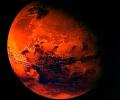
The launch of India's Mars Orbiter Mission has been delayed by almost a week and a decision on the new date would be taken on October 22, the Indian Space Research Organisation said on Saturday. The launch window for the MOM mission was earlier slated from October 28 to November 19 and a decision on the launch date was to be taken on Saturday.

The rocket is the first step in Musk's ambitious dream to send humans to Mars and establish a colony on the planet.

The Mars mission is overwhelmingly irrelevant to space science and won't advance the frontiers of knowledge. It will divert attention from the real technological challenges facing the Indian space programme, and will further distort our science and technology priorities, says Praful Bidwai.

Ahead of India's Mars orbiter's scheduled rendezvous with the red planet on September 24, ISRO is all set for the crucial fourth trajectory correction manoeuvre and test fire of the main liquid engine on the spacecraft on Monday.

On Monday, ISRO scientists will run a test of the Mars orbiter satellite's main engine and make a small course correction. This is crucial because the engine has been idle for nearly 10 months. T E Narasimhan reports

Indian Space and Research Organisation's Mars Orbiter Mission and American National Aeronautics and Space Administration's orbiter mission Mars Atmosphere and Volatile Evolution or MAVEN will share data concerning the upper atmosphere of Mars.
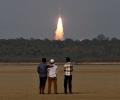
As NASA's Perseverance rover landed on Mars to look for signs of past life, ISRO chief K Sivan said India's next mission to the Red Planet is likely to be an orbiter.

The presence of phosphine in Venus's thick atmosphere has revived the age-old question: Are we alone?

All progress in space should excite us and encourage us to be optimists about a better future for our planet and all of us, asserts Aakar Patel.

ISRO hopes to put a crew on the moon, but it has to learn how to keep people alive and healthy in space first.

Here are list of some of the big ticket announcements.
'The benchmark was set by Dr Sarabhai.' 'If there is a problem, everybody would be encouraged to come up with a solution.' 'The final solution will be the result of all the inputs.' 'This is passed on through time.' 'Even today, you see that nobody wants to take particular credit on a success.'

'ISRO's style is a terrific example of being able to survive, acknowledge failures, and then most importantly of all, learn from them to ensure that subsequent missions are successful.'

'How will someone who has stood on Mars and looked at Earth, only a tiny blue dot in space, then see the idea of nations and religions and all of our divisions?' says Aakar Patel.

It has already tasted success with the moon mission and Mangalyaan. Is man in space the next frontier for ISRO?

Deciphering its secrets will unlock the early history of not only our planet, but also of the star system, explains Kumar Abishek.

The International Astronomical Union (IAU), an organisation which assigns official names and designations to celestial bodies, has recently confirmed the discovery of 18 new asteroids by Indian students as part of a global science programme.

The spacecraft is the first to take the American astronauts to orbit from American soil in nearly a decade.


Blockbusters of the year, serial killer of Bollywood movie critics, goth teen queens discovering psychic powers and Groot in holiday mood, it's all there on OTT this week.

Stephen Hawking, in his final book Brief Answers to the Big Questions, considered an asteroid collision to be the biggest threat to the planet. At this point, we are as well prepared as dinosaurs were when a 10-km wide asteroid hit the planet 65 million years ago, notes Kumar Abishek.
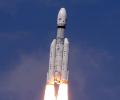
India is attempting to soft-land a rover on the moon and will attempt, at some point next year hopefully, sending humans into orbit. All of this makes an exciting time for space around the world, notes Aakar Patel.
A team from Jalandhar-based Apeejay School has won the gold medal in a "Space Settlement Design Competition".

From The New York Times to BBC and The Guardian to The Washington Post, the historic event in India's space programme on Wednesday made headlines across the globe.

India scripted history as the ambitious third Moon mission of the Indian Space Research Organisation (ISRO) touched down on the Moon's south pole, propelling the country to an exclusive club of four and making it the first nation to land on the uncharted surface.

Mission Mangal has its heart in place, feels Sukanya Verma.

Almost 20 days after it successfully entered the orbit of the Red Planet, ISRO's Mars Orbiter has sent pictures of Phobos -- the largest of the two natural satellites that orbit around Mars.

Sukanya Verma looks at the handful of occasions when Bollywood believed sky was the limit.

ISRO chairman A S Kiran Kumar talks of what's on and what lies ahead for the Indian space agency.

Chandrayaan-3's success is a must for India's space ambitions; we can't afford to lose out. And for realising our space dreams, the Indian private sector must be encouraged because if we lose this race, the moon, Mars, and mineral-rich asteroids will already be crowded before we reach there.
Pictures taken from NASA's Mars Reconnaissance Orbiter spacecraft showed finger-like features which may be flows of salty water spilling over the rims of craters

India, with its demonstrated capabilities of undertaking low cost high value inter-planetary travel, offers great opportunities for NASA to work with.

Readers have responded resoundingly to our invitation to congratulate the ISRO team for Chandrayaan-3's successful Moon landing.


On the morning of February 15, ISRO will hurl into space using the Polar Satellite Launch Vehicle three Indian satellites and 101 small foreign satellites. No other country has ever tried to hit a century in a single mission.
NASA has released the first-ever natural-colour portrait of Saturn, in which the planet, its seven moons and rings, and Earth, Venus and Mars, all are visible.

This demonstration of technology is exciting, as is the fact that it has been done with so little expense, says M N Vahia
Fourteen billion dollars goes a long, long way; it would buy you three US aircraft carriers or six NASA rover missions to Mars.
 © 2026 Rediff.com - Advertise with us - Disclaimer - Privacy Policy - Sitemap - Feedback - About us - Terms of use - Grievances